
Future direction after EMIS Web
Conceptual Design : Designing a safe contextual One-Off Nomination experience for EMIS X

Bridge from EMIS Web to EMIS X
Why EMIS X changes the opportunity
In EMIS Web, the clinician has to recognise the need for One-Off Nomination, open the nomination area, choose One-Off Pharmacy and click Find. That gives control, but it separates the decision from the prescribing context. EMIS X creates an opportunity to surface pharmacy guidance at the point of prescribing rather than requiring clinicians to initiate a separate search journey.
EMIS Web pattern
EMIS-X OPPORTUNITY
OON is accessed through a separate nomination-management action.
Helps understand whether the patient already has a dispensing route and whether location context may matter.
The clinician must remember when OON may be appropriate.
Relevant patient, prescribing and pharmacy context can be checked earlier.
The search experience is manual and form-led.
The experience can support contextual guidance while keeping the standard route available.
The desktop workflow is constrained by established patterns.
The cloud product can use connected service capability and more responsive patterns.
Product feasibility
What EMIS X would need to support this safely
I treated this as a product feasibility problem, not only an interface idea. The concept assumes EMIS X has access to core patient, prescribing and nomination context, and could leverage connected pharmacy service integrations where available.
PATIENT CONTEXT
Patient demographics, registered address, temporary address where captured, and existing nomination status.
Prescribing context
What is being issued
Acute/repeat context, issue timing, prescription method and whether the medication is being issued now.
Nomination context
Current route
Primary nomination and whether a one-off nomination is being selected for this prescription only.
Connected services
Pharmacy signals
Pharmacy directory/search data, opening hours and EPS-related service information where available.
Important product constraint
Important constraint: the quality of any prompt depends on service integration availability, data accuracy, clinical governance and Engineering validation.
Clinical decision support pattern
How the contextual prompt would work
Clinical decision support means using relevant information to help the clinician at the right moment. In this concept, EMIS X recognises context, explains the recommendation, and presents the most appropriate next action.
The safest pattern is: EMIS X notices context, explains the reason, and leaves the decision with the prescriber.


FACT
OON should remain temporary
One-Off Nomination applies to this prescription and must not replace the patient’s primary nomination.
INSIGHT
The task is not “search pharmacy”
The real decision is whether the patient can realistically use their usual dispensing route right now.
ASSUMPTION
Memory burden can be reduced
EMIS X can surface OON when context makes it relevant, rather than relying entirely on clinician recall.
Challenges and principles
Designing the prompt responsibly
Challenge
Avoid alert fatigue
The prompt should appear only when evidence is strong enough to be useful.
Challenge
Explain the reason clearly
The prompt must clearly say why it appeared, such as “primary pharmacy appears closed”.
Challenge
Handle uncertain data
Opening hours and service information may be incomplete, so language must remain careful.
Design principle
Application
P1 — Standard first
Do not interrupt routine medication issue when the nominated route looks suitable.
P2 — Recommend, don’t decide
The prompt supports a decision; the clinician remains responsible for the final choice.
P3 — Protect nomination
Make it explicit that selecting a one-off pharmacy will not change the primary nomination.
CONCEPTUAL DESIGN
Design options explored
I explored three options. Each keeps clinician control, but they differ in timing, interruption level and product maturity.
Option A
Manual OON action in issue panel
Bring the EMIS Web manual action into the EMIS X issue panel.

Why not recommended
Safe and simple, but still relies on clinician memory. It does not use EMIS X’s potential to support the decision contextually.
Option B
Recommended
Contextual OON prompt inside medication issue
Prompt only when patient, prescription and pharmacy context suggests the usual route may not be suitable.

Why recommended
It uses connected context without removing control. The prescriber stays in the medication workflow, understands why the prompt appeared, and can choose the safest next step.
Recommended EMIS X flow
From standard issue to one-off pharmacy selection
This is the future flow I would recommend after service integrations and clinical safety governance are validated.
STEP 01
Standard medication issue flow
The clinician selects medication and clicks Issue. No OON prompt appears yet because the system should not interrupt before it has checked context.

STEP2
EMIS X to checks contextual signals before showing anything
The system checks whether the primary route appears suitable. If there is no issue, nothing changes. If there is a meaningful signal, the prompt appears.
Patient
Primary Nomination
Primary pharmacy exists.
PRESCRIPTION
Urgency
Acute medication, issue now.
SERVICE
Opening hours
Primary pharmacy appears closed.
RULE
OON relevance
Prompt is appropriate.
STEP 3
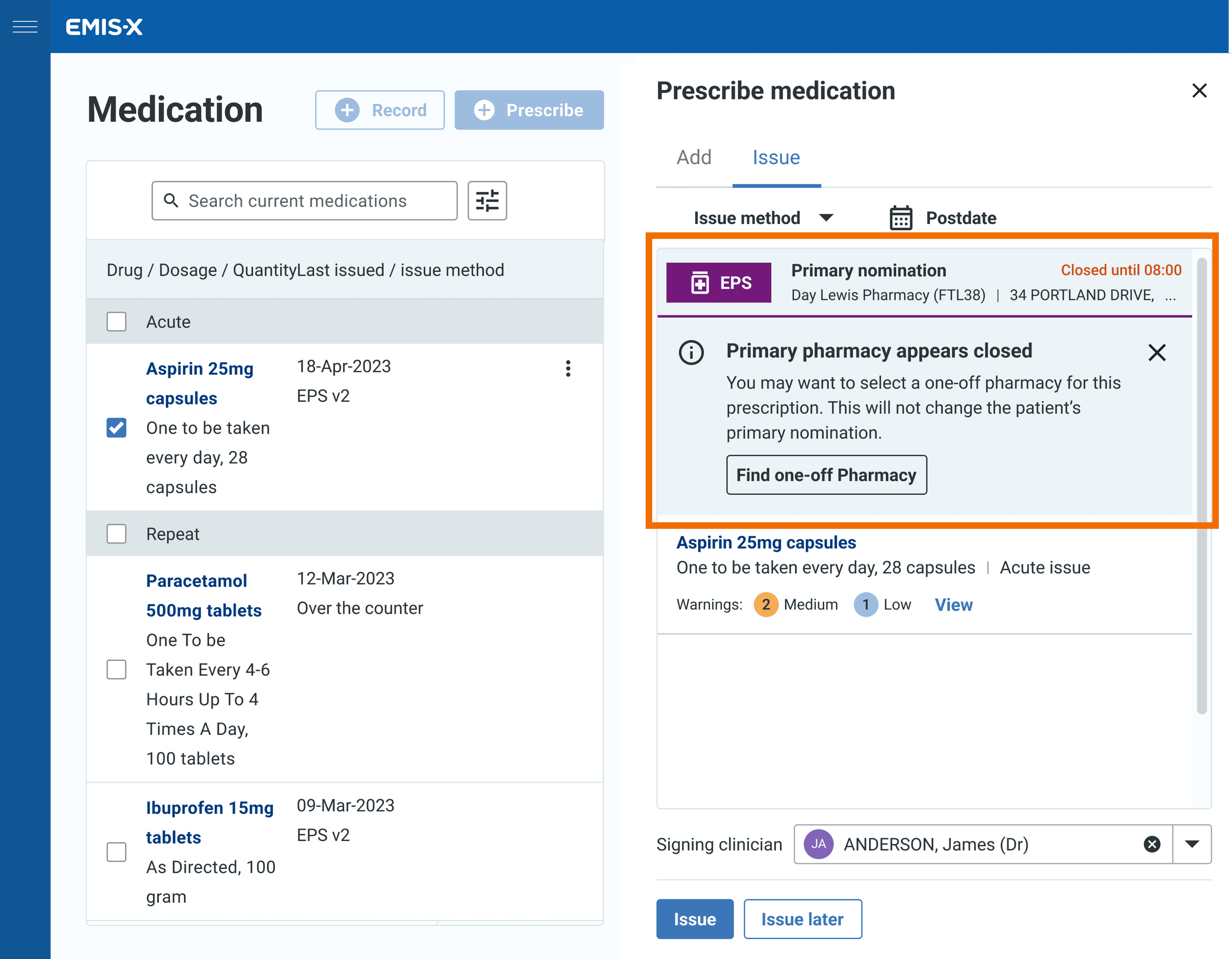
A contextual OON prompt appears inside the issue panel
The prompt explains the reason. It does not block the clinician unless the workflow requires it. The wording remains careful because service data can be imperfect.
STEP 4
Selects One-off Pharmacy
If the prescriber chooses to find a One-Off Pharmacy, EMIS X opens a focused selection drawer. Results are based on connected pharmacy service information and sorted around the clinical need: open, nearby, and EPS-capable where data supports it.


STEP 5
Return to issue panel

RECOMMENDATION
What I would recommend shipping
I would recommend shipping the contextual prompt as a future EMIS X concept only after service integrations and clinical safety governance are validated.
Recommended scope
Safe first release
Manual OON route always available.
Prompt only for high-confidence signals such as no nomination or primary pharmacy appears closed.
Never auto-select or change the pharmacy.
Measure carefully
Prompt acceptance rate.
Dismissal and override rate.
Time from prompt to pharmacy selection.
Validate before scale
Clinical safety review.
Engineering feasibility review.
Data reliability checks for connected services.
The design direction is safe because it keeps the standard prescribing route intact, while giving clinicians contextual support when the usual dispensing route may not be suitable.
IMPACT & REFLECTION
From a shipped EMIS Web solution to a future EMIS X opportunity
The shipped EMIS Web work solved the immediate reliability problem for One-Off Pharmacy search. The EMIS X concept extends the same learning into a safer, more contextual prescribing experience — while clearly separating what was delivered from what is a future-facing recommendation.
SHIPPED IMPACT · EMIS Web
Pharmacy search became more reliable under pressure
CLINICAL IMPACT
Made search failures easier to recover from during urgent prescribing tasks.
Provided clear next steps when pharmacy searches could only partially recover.
PRODUCT IMPACT
Shifted the focus from search usability to prescribing reliability.
Created reusable recovery and fallback patterns for future prescribing workflows.
team impact
Established a shared decision-making framework across cross-functional teams.
Focused discussions on clinical safety, feasibility, and workflow impact over UI preferences.
Future impact · EMIS X
The opportunity is to reduce reliance on clinician memory
Identified how contextual pharmacy guidance could fit within the prescribing workflow.
Defined the capabilities, service integrations, governance requirements, and safety principles needed to support future clinical decision support.
Established a future direction for EMIS X while keeping the delivered EMIS Web solution grounded in current platform constraints.
Reflection
What initially appeared to be a pharmacy search problem turned out to be a reliability problem. By focusing on recovery, clarity, and clinician confidence, the design had a greater impact than redesigning the search interface alone. The most valuable outcome was helping clinicians understand what to do next when the usual dispensing route was no longer suitable.
The most valuable outcome was not a better pharmacy search. It was helping clinicians understand what to do next when the usual dispensing route was no longer suitable.