
CONTEXT & MY ROLE
Problem
A transfer could fail silently. Senders assumed access, and receivers couldn't tell what was missing or where it came from.
My role
I led the UX strategy from problem framing to delivery support, and initiated the prioritisation session that shaped the three phases.
Decisions
Show source, provenance and CWB status first. Resend one consultation at a time, with the failure reason next to the action. Move partner setup to administrators.
Outcome
Show source and status first. Resend one consultation at a time, with the failure reason next to the action. Move partner setup to administrators.
This project is under NDA. Some details and visuals are adapted to protect sensitive information while accurately reflecting the problem, process and outcomes.
CONTEXT & MY ROLE
The missing record was only part of the problem.
A clinician at a Primary care Network (PCN Hub) could finish a consultation for a patient visiting the Hub, record the details of the consultation using EMIS Web and expect that information to reach the patient’s registered GP (General Practitioner). Later the patient’s usual GP or any other clinician like specialist, nurses may open the record expecting the complete picture. When the write back failed, the expectation quietly break.
The work then continued outside the intended workflow: Chasing information, contacting support, and manually transferring notes through email and fax. Even when the information arrived, receiving practices could struggle to distinguish it from consultations recorded locally. The experience left two important questions unanswered: Did the information arrive and where did it come from?
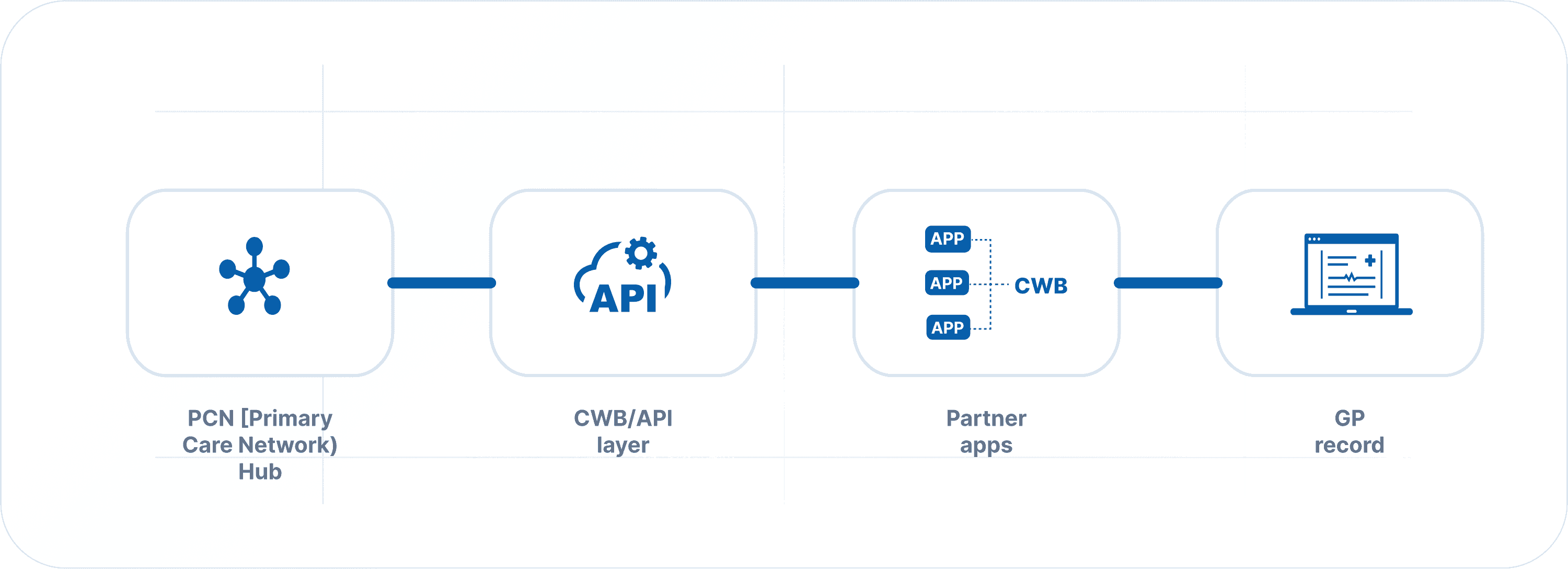
Consultation Write Back (CWB) is the mechanism for returning consultation records from one organisation to the patient’s registered practice in EMIS Web. My project addressed that experience across sending clinicians, receiving GPs, and administers, configuring partner applications.
MY ROLE
I owned the experience strategy from problem framing to delivery support
I represented UX in the cross-functional team. I reviewed requirements with the product triad, conducted Stakeholder interviews and focus group discovery, evaluated the existing experience, and designed in phased work.
When competing needs emerged, I initiated an Impact vs Effort prioritization session with Product and Engineering to make the trade-offs visible.
⌕
Reframed the
problem
Moved the conversation
from UI enhancement to clinical safety, continuity of care, and trust in record exchange.
⌁
Mapped the
workflow
Connected insights from focus groups, support tickets, heuristic review,
and workflow analysis to locate failure points.
↻
Designed
recovery
Created visibility
indicators, actionable
error states, bulk resend, selective resend, and retry behavior rules.
✓
Supported
delivery
Documented states, edge cases, status logic, permissions, configuration
patterns, and handoff
guidance.
DISCOVERY
I started with the work people did when the system led them down.
The initial brief focused on integration and reducing administrative friction. I reviewed requirements with the product triad, then brought together stakeholder interviews, user feedback and support tickets. That showed the pieces were connected: partner integration gaps, weak status feedback, limited recovery, technical error messages and missing source context.
What I found
Silence read as success. With no feedback, users assumed the write back had worked.
Failure had no recovery path. Calls, emails and repeated checking filled the gap.
Data without provenance created risk. External consultations blended into local records.
Ownership was unclear. A practice manager, clinician said it was hard to tell where a failure sat, so a status label alone wouldn't tell anyone what to do next.
DISCOVERY
Practice manager added another concern: When something failed, it was difficult to tell where the problem sat. That made the experience an issue of ownership as well as visibility. A status label would have limited value if it still left people unsure what to do next.
What I took forward
I synthesized the findings into three needs: make the origin of information recognizable; make transfer status understandable; and connect failures to an appropriate next action. Partner configuration sat underneath all three, because some consultations could not use the pathway in the first place.

HEURISTIC REVIEW
“Clunky” became a set of specific design problems.
General feedback described CWB as confusing and unintuitive. We expected usability issues but we found a trust problem. I turned that language into issues the team could act on. I reviewed the end to end experience against Nielsen’s ten usability heuristics, following a consultation from the sending practice into the receiving record.
The review exposed a gap between what clinicians expected and what the system made visible. The table below connects documented findings to the heuristic principles they illustrate; the principle mapping is a synthesis of the review.
This review gave me a more useful framing than “improve the interface.” The design needed to close the distance between a system event and a clinician’s understanding of that event.

The brief
What discovery showed
Integration and reducing administrative friction; add a label, show a message, expose a status.
A quiet failure in a clinical transfer creates false confidence. This is a continuity and trust problem, and a label without a next step wouldn't fix it.

Several ideas were valuable. They could not all come first.
We could add visual differentiation, create recovery controls, enable partner applications, improve auditability or explore bulk resend. Each addressed a real need. But the technical discovery also identified unreliable failure-state detection and limited background processing. The immediate planning constraints made sequencing a design problem in it’s own right.
I initiated a collaborative prioritization session with Product and Engineering and suggested an Impact vs Effort Matrix. My contribution was to bring the user problems into the planning conversation early enough to influence scope. Product brought delivery priorities; Engineering and Architecture brought the cost and dependencies behind seemingly simple actions.
Product managers, Engineering and the Technical Architect joined the session. We listed every candidate idea on a shared board, placed each one on the Impact vs Effort matrix as a group, and used reactions to show support. Engineering and Architecture challenged the effort estimates, and Product weighed impact against delivery priorities.

The useful tension: a small cue versus a deeper capability
Visual differentiation landed in the high-impact, lower-effort area. Resend and partner configuration also scored high on impact but needed more effort. That helped the team agree to ship the small, clear change first and sequence the larger capabilities behind it. Audit trails and retrospective labels sat in lower-impact, lower-effort; bulk resend and legacy investigation in lower-impact, higher-effort. These were relative priorities for this release, not a judgment that those ideas lacked value.
A trade-off we had to settle: Bulk resend was an attractive idea because it would clear many failed consultations at once. Engineering raised the cost behind it: when to retry, how to track attempts and prevent endless retries, and the server load of resending many records together. I weighed that against the user need and recommended starting with single-consultation resend and visible status, so clinicians could recover failures without us shipping a retry mechanism we couldn't yet make safe. We agreed to take single resend into the MVP.
I recognised that more screens would not resolve competing priorities, so I created a shared artifact the team could argue over.
PHASED DESIGN
First, help the receiving clinician recognize what arrived.
A written-back consultation could look like one entered locally. I designed an icon in a dedicated column, with a tooltip showing the source and the received date and time, so clinicians didn't have to open another workflow to understand where an entry came from. The cue extends into other record modules such as medication and problems, investigations, Coded history.

Phase 1 design: The icon and tooltip to identify written-back consultations and their origin. This is added to the Receiving Practice - Patient’s usual GP
PHASE 2 DESIGN
A failed transfer is not always the reason for resend.
The obvious next step was to make the reason for failure in Write back explicit. But as I worked through resend with triad, the action became more complicated than it’s label suggested. A temporary connection problem, an inactive sharing agreement, and an unknown status could all leave a clinician with missing information. They did not justify the same response.
Error scenarios like network errors, session timeouts and internal server error needs to be distinguished from persistent conditions such as no sharing agreement or no usual GP. With unreliable failure detection, I could not assume that every ambiguous record represent a confirmed, recoverable failure.
The design question changed from “Where should the Resend button go?” to “What does the clinician need to know before choosing it?”
I explored recovery in the clinician’s existing workflow.
The obvious next step was to make the failure reason explicit. But a temporary connection problem, an inactive sharing agreement and an unknown status all leave information missing, and they don't justify the same response. The design question changed from "where should the Resend button go?" to "what does the clinician need to know before choosing it?"
I explored two entry points: a Resend button in the ribbon (easy to find) and a contextual menu beside the selected consultation. I also explored "Resend all" with a multi-select dialog. Bulk resend raised questions about when to retry, how to track attempts and prevent endless retries, and how to manage server load. Resending one consultation at a time was simpler and lower risk, so it went into the MVP. The ribbon action was selected for the Phase 2 build, together with a status column and explanatory error feedback. Bulk resend was deferred from the MVP.
Phase 2: Single resend, status column and explanatory error feedback.
Phase 2 · Recovery options
Resend consultation using the Ribbon action button

Resend consultation actions in contextual resend menu

MOST INTERESTING CHALLENGE
A failed transfer is not always a reason for resend.
I split failures by what the clinician can actually do next. This table is the logic I designed the messaging around, agreed with Engineering [keep only if true]. Retry timing and attempt limits were [confirmed / still open] at handoff.
Design recommendation, not a confirmed safeguard: allow a limited number of manual resends per consultation, show the attempt count and last outcome in the status, and stop offering Resend once a persistent failure is detected. The cap itself is an Engineering decision, based on failure data and server load.
What remains unresolved. If a consultation reached the GP but the sender can't tell, a green "Sent" label risks implying success. I flagged unreliable failure and receipt detection to Engineering as something to resolve outside the interface.

PHASE 3 DESIGN
Manage Partner configuration: Partner configuration needed a smaller intervention.
Recovery addressed what happened after a transfer problem. Phase 3 addressed whether consultations data stored in third party applications like Accurx, econsult, AskMyGP, Ardens could be missed to reach the patient’s registered GP practice record.

The final MVP design is approved for the design to allow the admins to enable Consultation Write Back configuration from the existing Partner API Configuration ribbon.
PARTNER APP DECISION
We had agreed on the design. Then we had to rethink it.
Consultations recorded in partner apps could miss the registered GP record. There was no clear indication that the information was missing—and no agreed way to address the gap.
I began by investigating the workflow. Months later, a design we had treated as settled ran into architectural constraints as it approached delivery. I had helped agree that design. Now I needed to help the team reconsider it.
The first call · August 2022
The Product Manager opened the call with a problem, not a solution. Consultations recorded through partner apps weren't being written back to the patient's registered GP record through CWB. Nobody on the call could say how many consultations were affected, or for how long. A pause followed, the kind that tells you a problem is real. It was a clear problem with no clear answer.
The demo
I did what I do when a problem is bigger than the room's understanding of it: I asked to see it working.Before proposing a fix, I asked Engineering for a demonstration. I followed the consultation from the sending side to the receiving side, then examined what an administrator could do in the Partner Application configuration screen.
I needed to distinguish the record flow from the configuration that supported it. Where could an administrator act, and what would bring them to that action?
Where it had to live
Partner applications were already activated and managed in EMAS Manager. That made it the logical home for partner-specific CWB configuration. It also suggested an important opportunity: bring the setting to the administrator's attention when they activate the application.
That investigation gave me a basis for the design decision: I could connect the administrator's task to the record flow and explain why the configuration belonged in EMAS Manager.
A reasonable design, with important checks still outstanding
Phase 1 and Phase 2 took priority. Around June 2023, we had already shared the Phase 3 partner configuration design idea: a CWB Configurations tab within Partner Applications, with a list of applications, a checkbox and status for each, and a details panel below.

The Phase 3 design the team agreed on: a CWB Configurations tab in EMAS Manager
It gave the settings a clear home and made configuration visible in one place. The team agreed on the direction. But what did that agreement establish?
We still needed architectural input and clinical review. We had also identified a need to evaluate the workflow with practice managers or administrators. Product would need to arrange that work, but the proposed pilot had no named owner or scheduled date.
Two Program Increments passed. The design remained our agreed direction, although those checks were still outstanding.
The surprise
When Product brought the pending CWB work back into PI planning, I agreed to a one-week design turnaround. We had already discussed the approach, and I expected only minor updates to the messages, confirmations and banner, followed by internal design approval and an annotated handoff to developers.
Then the Solution Architect told me the proposed design would not work within EMAS Manager’s existing architecture. The concerns covered state management, performance, integration of the new tab and consistency with existing UI patterns.
The concerns were reasonable. But they surfaced two Program Increments after we had agreed on the direction—and after I had committed to the timeline.
There was no time to redesign the structure. We needed a solution that could be built and released in a weeks time left out for Engineering handoff.
The constraint surfaced when the design reached delivery
When the Solution Architect assessed the design for delivery, concerns about its fit with the existing EMAS Manager architecture challenged the proposed approach. He revealed the concerns regarding the EMAS Manager's architecture requires complex restructuring with state management, performance, integration complexity and existing interface patterns. Those concerns had been documented, but they had not been resolved sufficiently to establish that the design was feasible.
We now had only a short delivery window in which to find another route.
Could we simplify the tab and keep the direction we had already agreed?
Decisions and trade-offs
CLINICAL REVIEW
Designs were reviewed with Clinical Design Directors, Clinical Safety officer and Information Governance.
Because this workflow affects patient records, I walked the Clinical Design Director, a practicing GP who reviews clinical designs at EMIS along with clinical safety officer through the design for each phase. These were design walkthroughs, not usability tests with end users.
Design recommendation, not a confirmed safeguard: allow a limited number of manual resends per consultation, show the attempt count and last outcome in the status, and stop offering Resend once a persistent failure is detected. The cap itself is an Engineering decision, based on failure data and server load.
What remains unresolved. If a consultation reached the GP but the sender can't tell, a green "Sent" label risks implying success. I flagged unreliable failure and receipt detection to Engineering as something to resolve outside the interface.
OUTCOMES & REFLECTION
What changed for clinicians?
Phase 1 added a visual cue for consultations that came from another practice. In feedback, clinicians described being able to spot those entries at a glance. Feedback on the recovery design pointed to clearer status and an easier way to manage failed transfers.
User impact
Reduced uncertainty for PCN Hub clinicians by making write-back
behavior visible and recoverable.
Improved confidence for receiving GPs by clarifying externally sourced
consultations and provenance.
Business impact
Reduced dependency on manual coordination, follow-up calls and support escalation for missing or
uncertain write-backs.
Supported broader adoption across PCN Hub workflows by making partner
gaps manageable.
Product impact
Established reusable patterns for failure visibility, controlled recovery and
partner configuration.
Created a more scalable foundation for future partner-enabled clinical
workflows.
How I helped shape the scope
I connected what clinicians were telling us with decisions the team had to make. The prioritization workshop I initiated gave Product and Engineering a way to compare a small change that helped clinicians recognize incoming consultations with the greater effort of designing recovery and partner setup. That work shaped the three phases and helped us narrow recovery to individual resend and configuration to a dialog in the existing interface.
Before
The interface reinforced false success. Failed write-backs were silent. Manual workarounds absorbed clinical and admin time.
After
Status visibility made failures knowable. Resend made recovery possible. Partner configuration brought structural gaps into scope.


